Research ->Projects, Publications, Software & Datasets, People Projects -> Eye-Gaze Guided Human Computer Interaction
|
|||
| Eye-Guided Computer Interfaces | |||
|
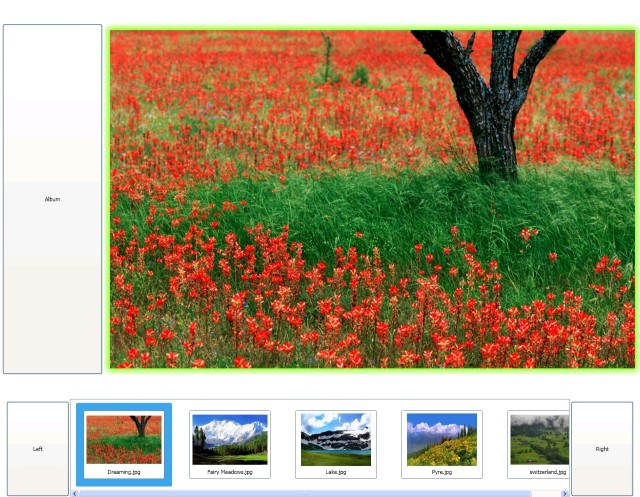
Goal: Interface design where eye movements are the primary or a part of an additional input modality. The interface intended for a normal PC user. Implementation: A concept of a photo browsing application was selected as an example of an application where an interface component control is done by the eye movement only. Mouse and keyboard were completely excluded from the design consideration from the very beginning of the development. Interface layout was created by understanding the imitations of the Human Visual System (constant eye movement) and eye tracking equipment (accuracy). Visual feedback was provided for every component and every selection state. Successful picture browsing was tested by 10 people. Project Status: Looking for students interested in the project. Please contact Dr. Komogortsev if interested in participation. |
||
| New Horizons of Eye-Gaze Guided Computer Interaction | |||
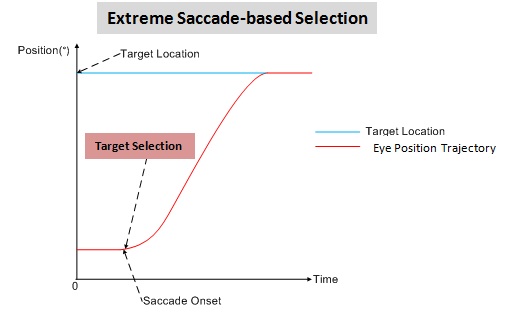 |
Goal: Developing new modes of eye-gaze based interaction, e.g., saccade-based interaction or pursuit based interaction providing more faster, natural ways to communicate with a computer. Motivation: The majority of the HCI systems use fixation duration (dwell time) as a trigger for interface actions. In such interfaces, the duration of the detected fixation initiates a “click”. Fixation-based selection necessitates data buffering and therefore introduces a delay in the system. In computer gaming the speed of “clicking” the target is of utmost importance and can be the difference between a victory or a loss. Therefore the motivation for the project is to find new interaction algorithms were the loss of the speed of the interaction is minimized. Project Status: Looking for students interested in the project. The students will participate in the development and the evaluation of the new interactive algorithms. Please contact Dr. Komogortsev if interested in participation. |
||
| Eye-Guided Gaming | |||
|
Goal: Eye-gaze guided interaction for World of Warcraft game. Implementation: Eye-gaze data controls mouse cursor in the World of Warcraft game. Eye position coordinates are processed by the Two State Kalman Filter (TSKF) modeling an eye as a system with translational motion represented by position, velocity and white noise acceleration. The TSKF determines the position of the mouse cursor. Mouse click is generated by a fixation with specified duration. [read more here]. Project Status: Looking for students interested in the project. Please contact Dr. Komogortsev if interested in participation. |
||
Publications: R. Fares, S. Fang, O. V. Komogortsev, Can We Beat the Mouse with MAGIC?, In Proceedings of the ACM Conference on Human Factors in Computing Systems (CHI), Paris, France, 2013, pp. 1-4. R. Fares, D. T. Downing, O. V. Komogortsev, Magic-Sense: Dynamic Cursor Sensitivity-Based Magic Pointing, In Proceedings of the ACM Conference on Human Factors in Computing Systems (CHI), Austin, TX, 2012, pp. 1-6. [.pdf] O. V. Komogortsev, C. Holland, and J. Camou, Adaptive eye-gaze-guided interfaces: design and performance evaluation, In Proceedings of the ACM Conference on Human Factors in Computing Systems (CHI), 2011, pp. 1255-1260. [link] O. V. Komogortsev, Y. S. Ryu, H. K. Do, and S. A. M. Gowda, Instantaneous Saccade Driven Eye Gaze Interaction. In Proceedings of ACM International Conference on Advances in Computer Entertainment Technology, 2009 pp. 1-8. [.pdf] Koh, D., Gowda, S., Komogortsev, O. Input Evaluation of an Eye-Gaze-Guided Interface: Kalman Filter vs. Velocity Threshold Eye Movement Identification. In Proceedings of of the ACM SIGCHI symposium on engineering interactive computing systems (EICS 2009), July 2009. [.pdf] Komogortsev, O., Khan, J., Kalman Filtering in the Design of Eye-Gaze-Guided Computer Interfaces. In Proceedings of the 12th International Conference on Human-Computer Interaction (HCI 2007), Beijing, China, July 22-27, 2007. pp. 679-689. [.pdf][project] [conference info] |
|||